📣 New paper alert, with Elly Koutamanis, Gerrit Jan Kootstra and Ton Dijkstra📣
🔎 What’s the paper about?
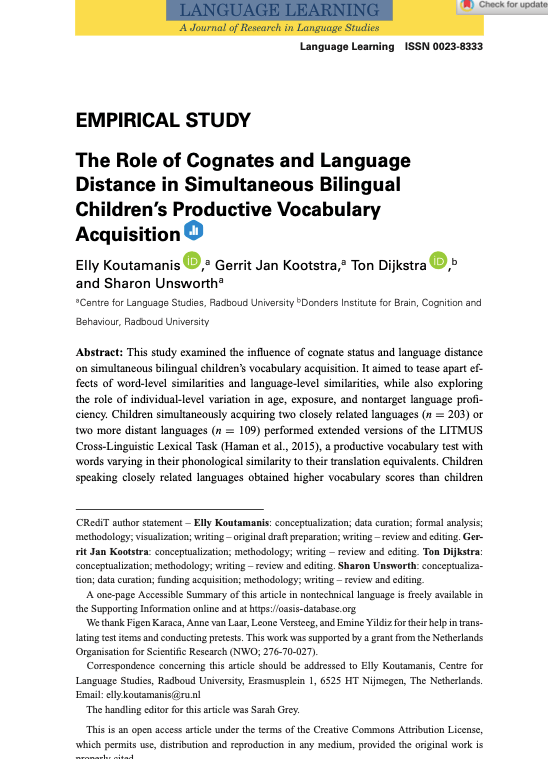
▶ Whether similarities between languages influenced how well bilingual children children performed on a vocabulary task in Dutch.
▶ We investigated similarities at the level of specific words (cognates vs. non-cognates) and in terms of language distance.
▶ We also explored the role of individual differences in age, exposure and proficiency in the other language.
🔎 What did we do?
▶ Around 300 bilingual children completed the production version of the LITMUS Cross-Linguistic Lexical Task (Haman et al., 2015). The words in this task vary in how similar they sound to their translation equivalents in the children’s heritage languages.
▶ Children’s heritage languages also differed in terms of similarity to Dutch: some were closely related (German or English) whereas others were a more distant language (Greek, Spanish, Turkish).
🔎 What did we find?
▶ There was an effect of language distance: children speaking closely related languages obtained higher vocabulary scores than children speaking more distant languages.
▶ There was also an effect of phonological similarity, which was stronger for the children in the distant language group. We argue that for these children, cognates may stand out more than for children acquiring closely related languages, leading to greater awareness and thus a stronger cognate effect.
▶ Importantly, when we removed the (near-)identical cognates from the test, the interaction between language distance and phonological similarity disappeared, but the effect of language distance remained. These findings show that similarities beyond specific test items and/or beyond the phonological level play a role in vocabulary acquisition.
▶ The effect of phonological similarity was also stronger for children with higher proficiency in their heritage language, in line with previous research.
🔎 Want to know more?
Koutamanis, E., Kootstra, G.J., Dijkstra, T. & Unsworth, S. (2024). The role of cognates and language distance in simultaneous bilingual children’s productive vocabulary acquisition. Language Learning.
 Sharon Unsworth